Assessment models are evolving, but the responsibility of institutions remains the same: conduct examinations that are fair, secure, and operationally accountable. Whether an examination is delivered at a test centre or from a remote location, its credibility depends on the integrity of the entire examination process.
This is why remote proctoring has gained attention across universities, certification bodies, recruitment agencies, and other assessment authorities. It is not replacing conventional examination models. Instead, it gives institutions another way to deliver assessments where remote participation is appropriate while maintaining governance standards and examination integrity.
What Are Remote Proctored Exams and How Do They Work?
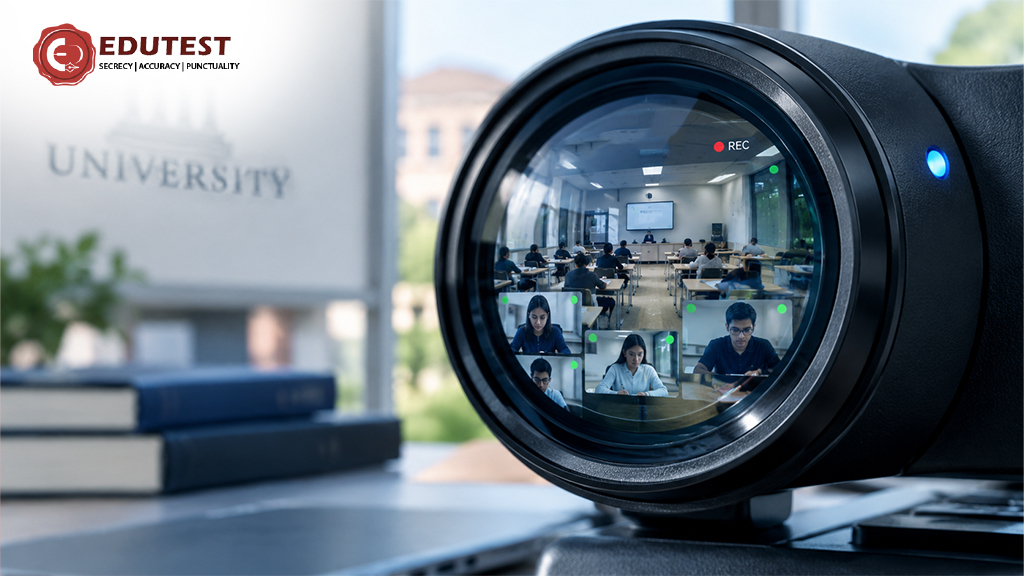
A remote proctored exam enables eligible candidates to take an examination from an approved location while the institution continues to monitor and govern the assessment process.
A typical workflow includes:
- Candidate identity verification before the examination begins
- Device and examination environment validation
- Secure access through a controlled examination interface
- Live and AI-assisted monitoring during the assessment
- Recording of examination events for review where required
- Audit trails that support examination transparency and accountability
These capabilities are available in many remote proctoring solutions. What differentiates a dependable examination system is how consistently they are executed through clearly defined processes, trained personnel, and operational oversight.
For institutions, the discussion quickly moves beyond how remote proctoring works to where it can create value within their broader assessment strategy.
Why Educational Institutions Are Shifting to Remote Proctored Exams
Institutions today often manage examinations across multiple locations, varying candidate volumes, and different assessment schedules. At the same time, they must continue meeting the governance expectations attached to every examination.
A remotely proctored exam provides additional flexibility for examination scenarios where remote delivery aligns with institutional policies, regulatory requirements, and candidate accessibility.
Many institutions are adopting remote proctoring to:
- Expand access for geographically distributed candidates
- Maintain examination continuity when physical attendance is not always practical
- Standardize examination processes across remote participants
- Scale digital assessments without increasing operational complexity
- Strengthen existing digital examination capabilities
From EduTest’s perspective, the first question should never be “Can this examination be conducted remotely?” It should be “Is remote delivery the right model for this examination?” Different assessment objectives require different delivery approaches, and selecting the appropriate examination model is fundamental to preserving integrity.
Once that decision is made, institutions focus on how remote delivery supports secure examination operations.
Operational Benefits of a Remotely Proctored Exam
A well-designed online examination solution should strengthen examination governance rather than simply digitize the assessment.
When implemented within structured examination operations, remote proctoring offers several practical advantages:
- Consistent candidate verification across distributed locations
- Better operational visibility through centralized monitoring
- Standardized examination processes regardless of candidate location
- Faster review of examination incidents using structured audit records
- Scalable delivery for institutions managing different examination volumes
For governance-driven institutions, these operational benefits are often more important than the technology itself. Examination integrity is maintained when technology, process, people, and oversight work together throughout the assessment lifecycle.
That makes the evaluation of a remote proctoring solution much broader than a feature comparison.
Essential Features of a Reliable Remote Proctoring Solution
A dependable remote online proctoring solution should integrate with the institution’s wider examination ecosystem instead of functioning as an isolated monitoring tool.
Key capabilities include:
- Secure candidate authentication
- AI-assisted and live proctoring where appropriate
- Secure browser support
- Real-time monitoring and incident management
- Comprehensive reporting and audit logs
- Integration with an online exam platform
- Compatibility with a broader digital assessment platform
- Support for existing examination management services
- Infrastructure that can scale for large examination volumes
Decision-makers should also evaluate operational readiness alongside technical capabilities. Escalation processes, examination support, monitoring controls, and governance workflows are just as important as the software itself.
This integrated approach becomes increasingly valuable as examination programmes expand in scale and complexity.
How EduTest Enables Secure and Scalable Remote Proctored Exams
EduTest remotely proctored exam delivers as one component of its comprehensive examination ecosystem, alongside centre-based, paper-based, internet-based, and computer based exam delivery models.
This reflects an important principle: institutions should not adapt examinations to fit a technology. Technology should support the examination model that best serves the institution’s objectives and governance requirements.
EduTest supports this through secure examination solutions built around disciplined execution, including:
- End-to-end examination planning and administration
- Command centre monitoring
- Structured manpower deployment
- Process-led quality controls
- Secure operational workflows
- Complete examination execution support
This integrated approach enables institutions to conduct a secure online examination while maintaining the same operational accountability expected across every assessment format.
Future of Remote Proctored Exams in Digital Education
As digital assessment continues to evolve, institutions will increasingly combine physical test centres, digital examinations, and remote delivery based on examination objectives rather than relying on a single assessment model.
Within that broader ecosystem, remotely proctored exam capabilities will continue to support institutions that require greater flexibility without compromising governance, security, or examination integrity.
Ultimately, the success of any assessment does not depend on where it is conducted. It depends on whether every stage of the examination is executed with consistency, transparency, and accountability. Those principles remain constant across every examination model and continue to define trusted assessment systems.
A remote proctored exam allows candidates to take an examination from an approved location while the institution monitors the assessment using identity verification, device checks, live or AI-assisted proctoring, and examination audit records.
Institutions are adopting remote proctored exams to support geographically distributed candidates, improve examination flexibility, maintain standardized processes, scale digital assessments, and strengthen examination monitoring and accountability.
Institutions should look for secure candidate authentication, AI-assisted and live proctoring, secure browser support, real-time monitoring, incident management, audit logs, reporting, examination platform integration, and infrastructure that can support large examination volumes.