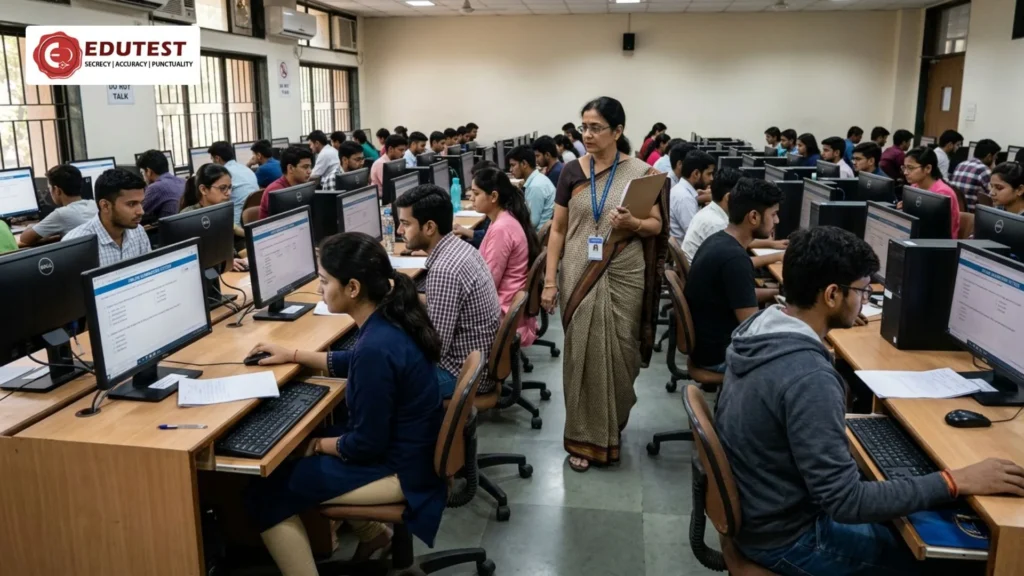
Examination administration is often viewed as an activity that begins when candidates enter the examination hall or log in to a testing system. In reality, the administrative effort begins much earlier and continues well after the examination is completed.
Institutions today are responsible for managing registrations, scheduling, candidate communication, examination delivery, result processing, compliance requirements, and audit documentation, often within strict timelines and governance frameworks.
As examination volumes increase, administrative complexity grows alongside them. More candidates, more locations, more stakeholders, and greater accountability create pressure on examination teams. This is why many institutions are adopting technology-enabled examination management frameworks supported by specialized execution partners.
Challenges of Traditional Exam Administration
Administrative burden rarely comes from a single task. It comes from coordinating multiple examination activities while ensuring every process remains accurate, secure, and accountable.
Institutions are often required to manage:
- Candidate registrations and data validation
- Examination scheduling and communication
- Resource and venue coordination
- Attendance and identity verification
- Examination monitoring and supervision
- Result compilation and reporting
- Compliance records and audit documentation
The challenge becomes more significant as the examination scale increases. What may be manageable for a few hundred candidates can become considerably more complex when thousands of candidates, multiple locations, and strict governance requirements are involved.
In many cases, examination teams spend substantial time coordinating activities across departments, vendors, centres, and stakeholders. The operational effort required to maintain control can become as demanding as the examination itself.
As a result, institutions increasingly look for ways to simplify administration without compromising reliability or compliance.
How Online Examination Services Streamline Exam Management
Effective online examination services do far more than digitize examinations. They create a structured, centralized framework that brings control, visibility, and accountability to every stage of the examination lifecycle.
The goal is not simply to replace paper-based processes. The goal is to transform how examinations are planned, managed, monitored, and reported.
With a robust examination management ecosystem, institutions can seamlessly coordinate:
- Candidate registration and scheduling
- Examination delivery and real-time monitoring
- Communication and notification workflows
- Attendance verification and identity validation
- Result processing and reporting
- Audit trails and compliance documentation
A reliable *online examination service* eliminates fragmented processes and reduces the burden of repetitive administrative coordination. Instead of managing multiple disconnected activities, institutions gain a unified view of examination operations from start to finish.
In our experience, most examination challenges do not arise from a lack of effort. They emerge when critical processes operate in isolation, creating gaps in visibility, delays in decision-making, and inconsistencies in execution.
This is where structured examination management delivers real value. By bringing every operational component into a single, accountable framework, *online examination services* help institutions improve efficiency, strengthen governance, and conduct examinations with greater confidence and control.
Reducing Manual Work Through Digital Exam Processes
Many examination activities involve repetitive administrative tasks that require continuous tracking, validation, and follow-up.
A well-designed online exam process helps reduce manual workload by automating routine activities while maintaining oversight and process controls.
Examples include:
- Automated candidate data validation
- Digital attendance and verification workflows
- Real-time monitoring support
- Centralized communication management
- Automated result compilation
- Consolidated reporting and record management
Similarly, a structured online test process improves coordination across examination teams by ensuring information flows through defined workflows rather than disconnected manual processes.
At EduTest, we have observed that reducing administrative burden is not simply about replacing paperwork with software. Sustainable efficiency comes from combining technology, operational discipline, and clearly defined responsibilities.
When these elements work together, institutions spend less time managing administrative complexity and more time focusing on examination outcomes.
Benefits of Online Examination Services for Institutions
The value of online examination services extends beyond operational efficiency.
For institutions, the benefits often include:
- Reduced administrative workload
- Better visibility across examination activities
- Improved coordination between stakeholders
- More accurate examination records
- Stronger audit readiness
- Greater scalability for large candidate volumes
- Consistent support for governance and compliance requirements
As examinations grow in size and complexity, institutions require systems that can maintain operational consistency without increasing administrative pressure at the same rate.
This is particularly important when organizations manage multiple examination formats, including computer-based testing, conventional examinations, hybrid models, and online remote proctored examination environments.
For decision-makers evaluating the best online exam platform, long-term value often depends on operational reliability, execution capability, governance alignment, and process accountability as much as technology itself.
How EduTest Simplifies Examination Management for Institutions
Examinations demand more than technology. They require dependable execution, structured processes, and accountability at every stage.
As an online examination company, EduTest supports institutions through end-to-end examination management services designed for governance-intensive examination environments.
Our approach combines technology infrastructure with operational execution frameworks that support examination administration from planning through reporting.
This includes:
- Examination planning and administration
- Candidate management support
- Secure examination delivery frameworks
- Command centre monitoring
- Structured manpower deployment
- Process-led quality controls
- Result processing and reporting
- Compliance-focused operational governance
Through Edutest examination services, institutions gain access to examination systems supported by teams experienced in managing large-scale assessment operations.
Whether supporting examinations through an online exam platform or delivering broader examination operations, the focus remains consistent: maintaining process control, execution accountability, and examination integrity throughout the lifecycle.
EduTest online examination services help institutions reduce administrative burden while supporting the reliability, security, and governance standards expected in modern examination environments.
Online examination services automate key tasks such as registration, scheduling, monitoring, and result processing, reducing manual effort.
They streamline workflows, enhance security, and simplify the administration of digital examinations from start to finish.
Institutions adopt these services to improve operational efficiency, reduce paperwork, and conduct secure, scalable, and reliable examinations.