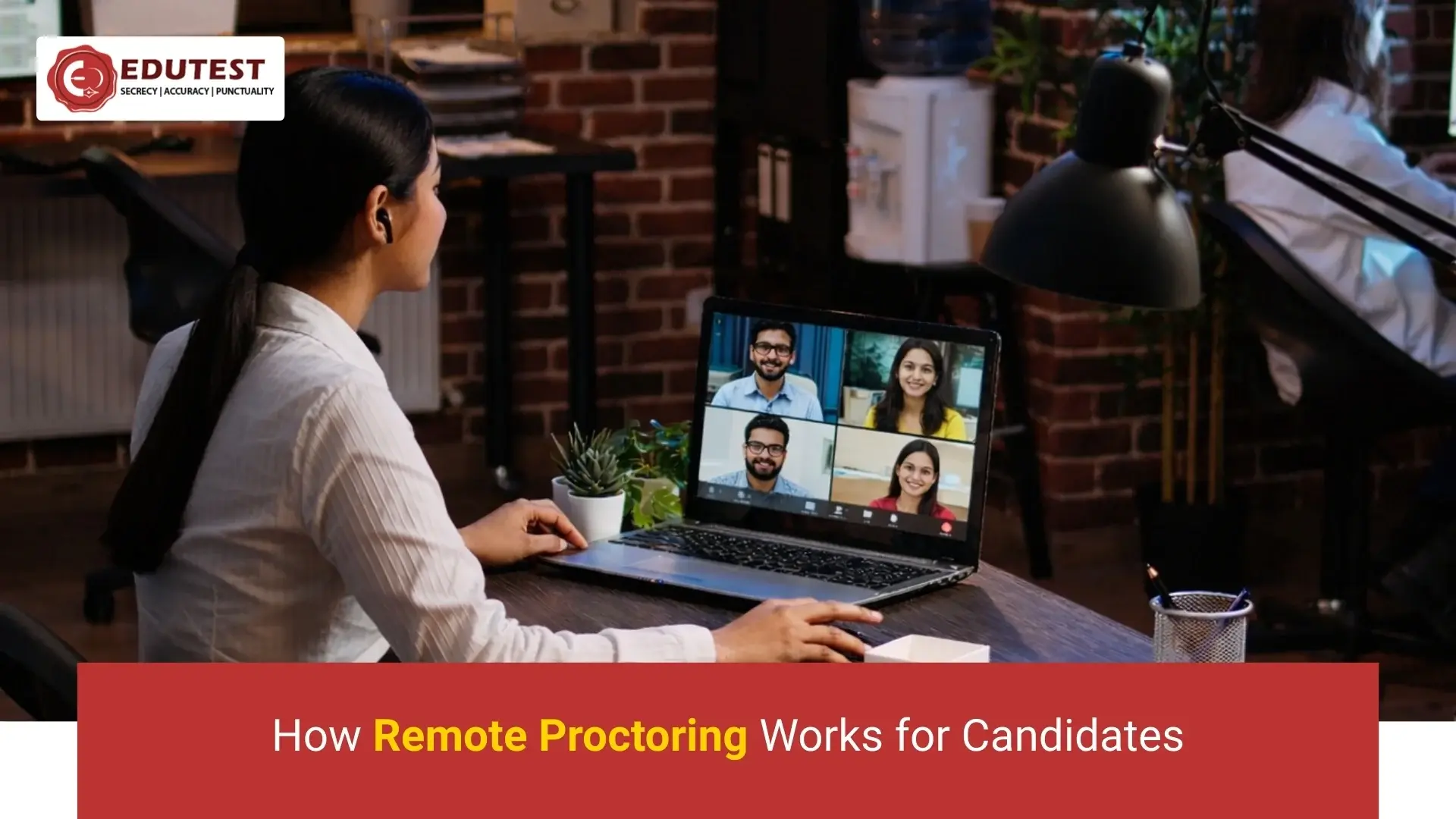
Candidates taking the national certification examination are able to log in from their own homes, hostels, training centers, or remote areas of the country, to which there are no central halls that can accommodate all candidates together, nor any corridor supervisors or groups of candidates who can assemble at a common location where questions are distributed. Yet the same expectations will be placed on each individual candidate.
Each candidate must go through an authentication process; there must be a monitoring process in place for each session; there must be an incident process to allow for traceability of the incidents that occur; and each candidate’s results must be able to withstand an independent audit. When assessments move outside physical centres, control cannot disappear. It has to be rebuilt digitally.
Remote proctoring exists to recreate the discipline of an exam environment without the hall itself. For institutions responsible for scale, compliance, and public trust, the concern is not whether supervision is required. The issue is how it is organized.
In the following sections, details of the way remote proctoring functions in practice, from system configuration to the learner’s experience, as well as the factors decision-makers will need to take into consideration when considering remote proctoring, will be outlined.
Remote Proctoring Used for Online Examinations
Remote proctoring is a structured oversight of a candidate’s performance on an online examination via the use of electronic means rather than a physical supervisor.
It replicates three essential functions of a traditional exam hall:
- Identity verification
- Environment monitoring
- Behaviour monitoring
In a controlled, Remotely Proctored Exam, these functions are managed through a combination of software controls, identity checks, and monitoring tools. The goal is not surveillance for its own sake. The goal is exam integrity at scale.
Institutions today use online exam proctoring to expand access without compromising control. For government bodies and universities, the shift is operational, not experimental.
Types of Remote Proctoring: AI, Live, and Recorded
Decision-makers typically evaluate three models. Each serves different risk profiles and scale requirements.
1. AI Remote Proctoring
In AI remote proctoring, automated exam proctoring tools monitor video, audio, and screen activity in real time. Suspicious behaviours are flagged through pattern detection.
Common flags include:
- Multiple faces in frame
- Frequent gaze diversion
- Background voices
- Screen switching
- Use of prohibited applications
This model supports high-volume recruitment exams and large university assessments. It allows rapid scale with consistent rule enforcement.
2. Live Proctored Exams
In live proctored exams, trained human invigilators monitor candidates through webcams in real time.
This model is used when:
- The exam is high stakes
- Candidate numbers are moderate
- Manual oversight is required
It mirrors physical invigilation but requires careful bandwidth and staffing planning.
3. Recorded Proctoring
Sessions are recorded and reviewed later if needed. This reduces immediate staffing needs while preserving audit capability.
Hybrid models are becoming the standard for how a lot of institutions do business.
To support a successful and compliant remote proctoring system, operationally, it should be appropriate to the level of exam risk, size, and regulatory requirements.
How to Remote Proctor: Candidate Steps
Understanding the online proctored test process from a candidate’s perspective helps institutions reduce friction.
A typical process includes:
- Pre-Exam System Check: Candidates test webcam, microphone, internet stability, and browser compatibility. Remote invigilation software performs environment diagnostics.
- Secure Login: Unique credentials are issued. Multi-factor authentication may be enabled.
- Identity Verification: Candidates upload ID documents. Facial recognition or live comparison may be used.
- Environment Scan: Candidates rotate their webcam to show the room. Desks must be clear.
- Exam Launch: Secure browser locks access to other applications.
- Continuous Monitoring: Video, audio, and screen activity are recorded or monitored live.
- Flag Review and Reporting: Incidents are logged for institutional review.
In a properly configured remotely proctored exam, these steps occur in a structured flow with minimal candidate confusion. The operational priority is predictability. Surprises create a support load.
System Requirements for Remote Proctored Exams
Infrastructure failure is a greater risk than misconduct.
Minimum requirements typically include:
- Stable internet connection
- Functional webcam and microphone
- Updated operating system
- Compatible browser or secure browser installation
- Quiet, well-lit environment
For large public exams, institutions must consider infrastructure realities. Not all candidates have high-speed broadband. Systems must tolerate temporary network drops without invalidating attempts unnecessarily.
At EDUTEST, the observation has been consistent: resilience matters more than sophistication. A secure online proctoring environment must degrade gracefully, not collapse under variance.
Identity Verification and Candidate Authentication Methods
Identity integrity begins before the first question loads.
Common authentication layers include:
- Government ID upload
- Facial recognition match
- Live photo capture
- One-time passwords
- Keystroke pattern analysis
Layering controls reduces impersonation risk. Decision-makers must balance strictness with accessibility. Excessive friction increases dropout rates. Weak authentication increases reputational risk.
Remote proctoring for students in large national exams requires a calibrated approach. Identity checks must be defensible in an audit but not exclusionary.
How AI Detects Cheating and Suspicious Behavior
There is often confusion about how remote proctoring works at the detection level. AI-based systems do not “understand intent.” They detect deviations from expected patterns.
Typical triggers include:
- Head movement frequency
- Eye gaze direction
- Audio anomalies
- Multiple monitor detection
- Browser tab switching
- Prohibited application launch
Each trigger generates a flag, not a verdict. Human reviewers examine context before any action is taken.
For decision-makers, this layered review model is critical. Automated systems scale detection. Human oversight ensures fairness.
In a large-scale proctored online assessment, thousands of minor flags may appear. Only a fraction requires escalation.
Webcam, Screen, and Audio Monitoring Explained
Remote exam monitoring relies on three streams:
Webcam Monitoring
Tracks candidate presence and environmental consistency.
Screen Monitoring
Records screen activity to prevent:
- Use of search engines
- Messaging applications
- External document access
Audio Monitoring
Captures background noise that may indicate external assistance. These streams are encrypted and stored per defined retention policies.
The objective is deterrence through structured oversight, not intrusion. When candidates understand that monitoring exists, misconduct rates typically decrease.
Candidate Guidelines Before and During Proctored Exams
Operational clarity reduces incident volume. Institutions should communicate clearly:
Before the Exam
- Perform system checks in advance
- Use a private, well-lit room
- Remove unauthorized materials
- Inform household members
During the Exam
- Remain visible in camera frame
- Avoid looking away repeatedly
- Do not use headphones unless permitted
- Do not leave the seat without permission
Misunderstandings, rather than bad intentions,create most issues with a remote proctored exam. Clear directions help reduce the possibility of false positives and candidate anxiety.
Privacy and Data Security When Using Remote Proctoring
Institutions looking to adopt online proctoring use data governance to guide their actions in creating secure remote proctoring frameworks. These often include:
- End-to-end encryption
- Restricted access to data
- Defined retention periods
- Role-based administrative controls
- Compliance with applicable data protection regulations
Trust is not built through claims. It is built through documented process controls.
Institutions must define:
- What data is collected
- Why it is collected
- How long it is retained
- Who can access it
Transparency reduces resistance from stakeholders and oversight bodies.
Common Issues Candidates Face and How to Avoid Them
Even well-designed systems encounter recurring challenges.
Typical issues include:
- Internet disconnections
- Inadequate lighting
- Unsupported devices
- Background noise
- Panic due to monitoring awareness
Mitigation strategies include:
- Mandatory mock tests
- Pre-exam system verification windows
- Clear helpline protocols
- Real-time technical support escalation
From an operational standpoint, exam integrity is not only about detecting cheating. It is about minimizing avoidable disruptions.
Institutional Considerations Moving Forward
Adoption of the remote proctoring system is no longer experimental in higher education and public recruitment.
Trends indicate:
- Increased hybrid exam models
- Greater regulatory scrutiny
- Stronger documentation requirements
- Demand for audit-ready reporting
Decision-makers should view remote invigilation software as infrastructure, not software alone.
A remotely proctored exam is successful when:
- Identity is verifiable
- Monitoring is consistent
- Data is governed responsibly
- Incident review is defensible
- Candidate experience remains manageable
Perfection is unrealistic. Control is engineered through layered systems. For institutions managing scale, geographic spread, and risk exposure, remote proctoring has become an operational instrument rather than a temporary alternative. And in large assessments, operations matter more than intention.
Closing Take
Remote proctoring will not only extend the institution’s existing accountability, but it will also increase that accountability. Policies need to be created, risk thresholds need to be established, and review mechanisms should be designed and documented. Remote Proctoring will merely enforce the rules that the institution has put in place through its governance structure.
As the method of assessment evolves away from a physical location, institutions will be held accountable for their ability to maintain a level of control and consistency throughout all assessments and to be ready to audit all proctored exams that happen online.
When implemented with operational discipline, secure online proctoring will provide a level of infrastructure that can allow for scaling, without compromising on standards, and will ensure that each proctored exam can be defended, identified, and verified as meeting the institution’s requirements.
Yes, most remote proctoring systems use advanced security technologies to protect both the exam process and candidate data. These systems often use encrypted connections, secure browsers, and AI monitoring to maintain exam integrity. Institutions also follow privacy policies to ensure candidate information is handled responsibly.
Remote proctoring systems are designed to detect suspicious behavior during exams. AI technology can flag activities such as switching tabs, unusual eye movements, the presence of additional people, or the use of unauthorized materials. These alerts are reviewed by proctors to determine if any rules were violated.
Candidates should test their system, internet connection, webcam, and microphone before the exam. They should also choose a quiet room, remove unauthorized materials from their desk, and carefully read the exam guidelines. Preparing the environment in advance helps avoid technical issues and ensures a smooth exam experience.