
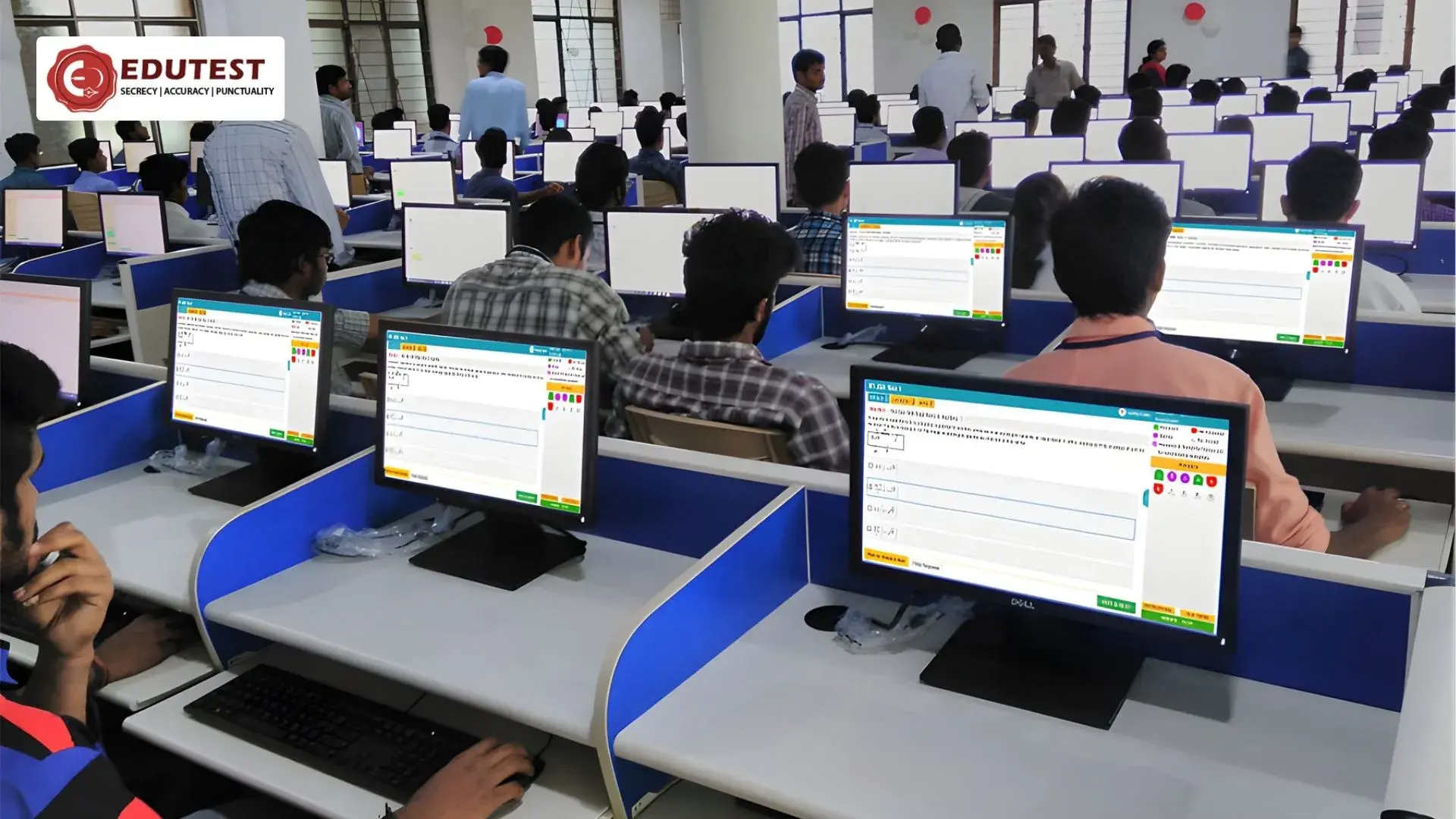
The National Examination for Recruitment will begin at 9:00 A.M., when millions of candidates will start logging in using their unique devices and networks from every part of the country. Help desks will be available to assist candidates, and huge increases in activity will be shown on the monitoring dashboards. Identity verification, server stress, and proctoring alerts will activate at the same time, and regions will coordinate efforts.
There is more to this overall operation than just the actual Examination. Control must be kept across four functions – Registration, Infrastructure, Monitoring, and Evaluation – without disrupting any candidates or compromising fairness.
This is where execution discipline matters more than technology claims. High-volume assessments demand systems that are designed to withstand pressure, not just perform in ideal conditions.
Challenges in Conducting High-Volume Government Exams
Conducting high volume government exams is not a question of digital migration. It is a question of operational reliability.
Every large-scale assessment faces predictable pressures:
- Simultaneous access spikes from candidates across multiple states
- Verification complexity for identity, eligibility, and documentation
- Infrastructure dependency on stable networks and load distribution
- Security threats, including impersonation and system misuse
- Coordination gaps across test centers, remote candidates, and administrators
These challenges are rarely visible to candidates. They are handled through systems designed to absorb scale rather than react to it.
For decision-makers, the concern is continuity. A government exam management system must perform consistently, not occasionally.
Edu-Test’s Scalable Exam Infrastructure Explained
Scalability is not a feature added later. It is designed from the start.
Edu-Test structures its scalable government testing platform around distributed infrastructure and process layering. This ensures that capacity expands without disrupting performance.
Key operational foundations include:
- Load distribution across multiple server nodes to avoid a single-point dependency
- Session balancing that maintains candidate continuity even under heavy traffic
- Redundant systems that activate automatically if performance thresholds shift
- Regional routing to minimize latency and ensure stable access
The objective is not speed alone. It is stability under unpredictable conditions. Large scale government testing depends less on one powerful system and more on coordinated, smaller systems working together.
Secure Candidate Registration & Verification Process
The exam process begins long before test day. Registration determines data quality, identity accuracy, and eligibility compliance.
Edu-Test approaches this through structured workflows aligned with a digital government exam process:
- Layered identity verification using document validation and authentication checks
- Eligibility filters mapped to recruitment rules and institutional criteria
- Duplicate detection mechanisms to prevent multiple registrations
- Audit trails for administrative oversight
This reduces manual intervention later in the cycle and prevents bottlenecks during admit card generation and scheduling. Security begins at registration. Exam-day enforcement alone is not enough.
High-Capacity Server Architecture for Mass Exams
Mass assessments rely on infrastructure that performs consistently under load, not just at peak speed.
Edu-Test’s high capacity exam software operates on an architecture designed for simultaneous candidate activity across regions:
- Elastic compute environments that adjust capacity based on demand
- Traffic isolation protocols separating exam sessions from administrative systems
- Failover routing to maintain continuity during disruptions
- Performance monitoring layers tracking response time and server health
A government CBT exam platform must maintain session integrity even if local network conditions vary. Candidates should not experience technical inequality due to geography. Infrastructure planning, therefore, focuses on resilience rather than raw capacity.
Data Security and Compliance Standards in Government Testing
Government exams involve sensitive data: identity records, eligibility details, and performance outcomes. Protection is a continuous process, not a policy statement.
Edu-Test operates within structured, secure government exam software protocols:
- Encrypted data transmission and storage across all candidate interactions
- Access controls limiting administrative privileges by role
- Compliance alignment with institutional data protection expectations
- Audit logging to track changes and system access
Trust is built through repeatable controls. Security frameworks must operate quietly in the background without affecting candidate experience.
AI-Based Proctoring and Fraud Prevention Measures
Fraud prevention is an operational necessity in any government recruitment exam system. Technology assists, but process discipline carries equal weight.
Edu-Test integrates monitoring and preventive mechanisms to support fairness:
- Behavior-based proctoring alerts during exam sessions
- Identity continuity checks throughout the assessment window
- Restricted browser environments to limit unauthorized activity
- Incident review workflows for administrative verification
Proctoring is not about surveillance intensity. It is about maintaining exam credibility while respecting candidate accessibility.
Multi-Location and Remote Exam Delivery Model
Government exams rarely occur in one format. Some candidates attend physical centers, others join remotely, and many operate in hybrid environments.
Edu-Test supports a nationwide exam delivery system designed for distributed execution:
- Center-based delivery coordination with standardized system setups
- Remote access frameworks with secure login and verification
- Regional scheduling flexibility for staggered exams
- Central monitoring dashboards connecting all exam locations
This ensures continuity across geographies while maintaining uniform standards. A government online exam platform must adapt to infrastructure differences without compromising assessment integrity.
Real-Time Monitoring and Incident Management
During live exams, response time defines system credibility.
Edu-Test implements operational oversight through structured monitoring:
- Live dashboards tracking attendance, system performance, and session activity
- Automated alerts for irregular behavior or system anomalies
- Regional coordination teams handling location-specific issues
- Escalation workflows ensuring quick administrative decisions
Real-time monitoring is less about visibility and more about controlled intervention. Small disruptions handled early prevent larger operational failures.
Automated Evaluation and Fast Result Processing
After exam completion, evaluation speed influences institutional timelines and candidate trust.
Edu-Test manages post-exam processes through automation within its Examination Services framework:
- Standardized answer processing aligned with exam formats
- Scoring automation reducing manual error
- Result validation workflows for administrative approval
- Structured reporting formats for institutional use
Automation supports accuracy and consistency. It also allows institutions to meet recruitment schedules without extended delays.
Case Examples of Large-Scale Government Exam Execution
Large-scale assessments reveal operational patterns that smaller exams do not.
Across multiple deployments involving mass candidate exam solutions, Edu-Test has observed consistent execution priorities:
- Early infrastructure stress testing reduces live exam uncertainty
- Pre-exam candidate communication lowers login-related disruptions
- Staggered scheduling models manage server load and regional coordination
- Centralized command structures improve incident response
In large programs using a government exam management system, success often depends on preparation discipline rather than technology upgrades.
Where Examination Services Fit in Institutional Decision-Making
Choosing reliable examination services is rarely about features. It is about accountability.
Decision-makers evaluate systems based on:
- Operational reliability across multiple exam cycles
- Process transparency and audit readiness
- Infrastructure adaptability for changing exam policies
- Institutional alignment rather than vendor dependency
Exam systems must integrate into existing governance structures, not replace them. The role of a scalable government testing platform is to support administrative control while reducing operational strain.
Industry Direction and Operational Realities
Government testing continues to move toward structured digital environments, but expectations are shifting.
Institutions now prioritize:
- Hybrid delivery models instead of single-format exams
- Security-first design over rapid deployment
- Auditability as a core requirement
- Operational resilience rather than one-time performance
A government online exam platform today is expected to function as infrastructure, not just software.
Closing Perspective
Running large assessments is less about conducting an exam and more about managing a coordinated system.
Edu-Test approaches examination services as an operational responsibility. Infrastructure, registration, monitoring, and evaluation are all viewed as one interconnected element versus independently existing modules.
In support of reliability for organizations running situations in which you will be conducting large amounts of government assessments, you are able to create a reliable operation through carefully controlled and repeated actions with the use of technology to sustain the results of disciplined application to the overall structure.
That is what allows large-scale assessments to run with stability, even when the scale keeps growing.
A high-volume government exam is a large-scale test conducted for thousands or even millions of candidates at the same time for recruitment, eligibility, or certification. These exams require a robust online testing platform, strong security systems, and reliable infrastructure to manage heavy traffic and ensure a smooth examination process.
Yes, Edu-Test includes real-time monitoring tools that allow administrators to track candidate activity, system performance, and exam progress. This helps quickly identify and resolve any issues during the exam.
Edu-Test is built with backup systems, auto-save functionality, and recovery mechanisms. These features help candidates continue their exams even if temporary connectivity or technical issues occur.