India’s examination ecosystem operates at a significant scale across recruitment exams, university assessments, entrance tests, and public examinations. Managing these environments requires institutions to balance operational efficiency, examination integrity, candidate experience, and governance accountability simultaneously.
As examination volumes increased, institutions also needed systems that offered better visibility, process standardization, and execution control. This is one of the reasons the computer based testing model has become increasingly important in large-scale examination environments.
Its role is not to replace every examination format, but to support assessments where scale, monitoring, and operational consistency are critical. A surprisingly practical approach from humanity for once.
Challenges of Traditional Examination Systems in India
Traditional examination models continue to remain relevant across many academic and institutional environments. However, large-scale execution introduces operational challenges that institutions must manage carefully.
Some of the most common challenges include:
- Coordination across multiple examination centres
- Physical handling and transportation of examination materials
- Manual verification and attendance processes
- Delays in evaluation and result processing
- Inconsistencies in centre-level administration
- Limited real-time monitoring during examination execution
For government recruitment bodies and public examination authorities, these challenges become more sensitive because examination integrity must remain accountable at every stage.
As examination cycles become larger and more time-sensitive, institutions increasingly require systems that improve visibility, standardization, and execution control within existing governance frameworks.
What is Computer-Based Testing (CBT)?
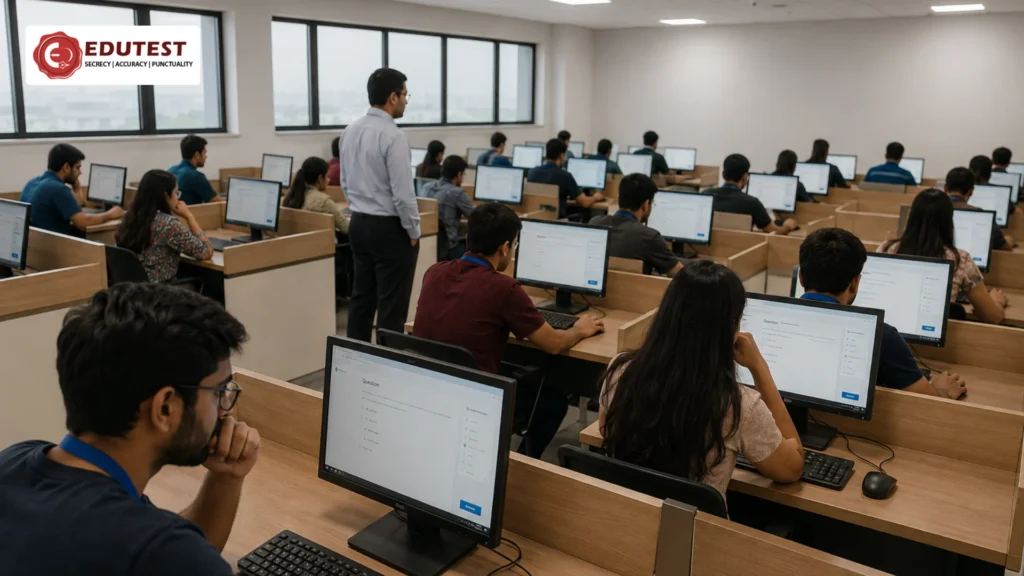
A computer based exam is an assessment conducted through digitally managed examination systems instead of traditional pen-and-paper workflows. Candidates appear for examinations at authorized centres using monitored computer systems connected to a centralized examination environment.
Today, the CBT exam system India institutions extends beyond basic online testing. Modern examination environments are designed to support:
- Encrypted question paper delivery
- Candidate authentication workflows
- Centralized monitoring systems
- Audit-ready operational controls
At an institutional level, the focus is on creating a more structured and traceable examination process.
This is where infrastructure and execution capability become equally important. A reliable, secure online exam platform must support governance-led examination delivery, not just software functionality.
Its operational value becomes more visible during large-scale examination execution.
Key Benefits of the Computer Based Test Model
For institutions managing high-volume examination cycles, the value of the computer based test model comes from operational consistency and process control.
Faster Examination Lifecycle
Digital workflows reduce dependency on physical logistics, manual compilation, and paper-based coordination. This helps institutions manage examination timelines and result processing more efficiently.
Better Scalability
A properly designed, scalable exam platform allows examinations to be conducted across multiple centres and cities through standardized operational frameworks.
Improved Administrative Visibility
Centralized monitoring systems provide examination authorities with better oversight during live examination execution.
Structured Candidate Experience
Standardized scheduling, verification processes, and centre operations help create a more consistent candidate experience across locations.
Role of CBT in Ensuring Secure and Fair Examinations
Security remains one of the most important responsibilities in examination administration.
In governance-heavy examination environments, examination security depends on both technology controls and operational discipline. A properly managed secure CBT platform combines controlled access environments, monitoring systems, process tracking, and documented escalation frameworks.
Fairness also depends on:
- Trained manpower deployment
- Standardized operational protocols
- Command centre supervision
- Centre-level compliance processes
- Secure custody and delivery frameworks
This operational layer is often overlooked in discussions around examination technology.
From the EduTest perspective, examination integrity is built through both infrastructure and execution discipline. Technology systems, field operations, monitoring teams, and process controls must function together within a structured governance framework.
Impact of CBT on Large-Scale Government and Competitive Exams
Government recruitment and competitive examinations require systems capable of handling large candidate volumes without compromising operational reliability.
This is where a large scale exam management system becomes important.
Many public examination authorities and institutional bodies are using CBT solutions for institutions to improve centre coordination, strengthen monitoring capabilities, and manage examination workflows more efficiently.
Execution responsibility also extends beyond platform deployment. Infrastructure readiness, centre operations, manpower deployment, and incident response planning all become part of examination delivery.
The EduTest CBT platform is designed around this operational reality, where examination execution must remain structured, traceable, and accountable across every stage of the process.
Future of CBT in India’s Examination Ecosystem
India’s examination ecosystem will likely continue operating through multiple examination models depending on institutional requirements, accessibility considerations, and assessment objectives.
However, digital examination infrastructure will continue expanding in environments where operational scale, monitoring, and execution efficiency are critical.
For examination authorities, the focus is no longer only on conducting examinations digitally. The larger priority is building systems that remain structured, secure, and operationally reliable at scale.
The EduTest exam solutions approach is built around this requirement, where technology, execution discipline, and governance processes must work together throughout the examination lifecycle.
Because in large public examination environments, trust is built through systems that continue functioning correctly under pressure.
CBT uses secure systems, randomized questions, and automated monitoring to reduce malpractice and maintain fairness.
CBT offers faster results, a smoother exam experience, and greater flexibility in managing large-scale tests.
CBT is expected to become the standard examination method as India continues adopting digital and technology-driven assessment systems.