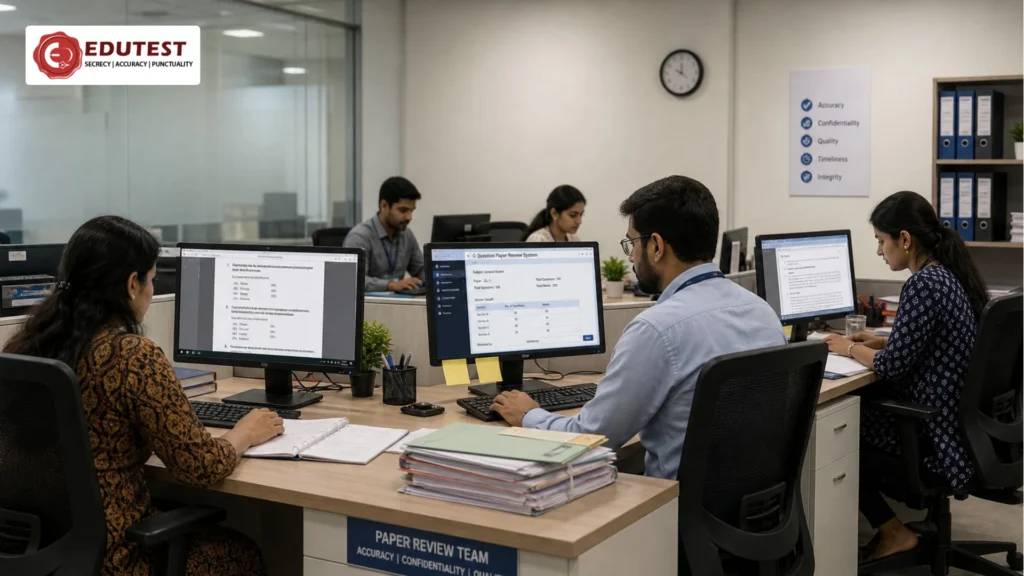
In large-scale government examinations, evaluation is where control is either maintained or lost.
The challenge is not just volume. It is managing:
- consistency across evaluators
- visibility into evaluation progress
- defensibility of final results
When answer sheets move physically and evaluation is distributed, gaps begin to appear:
- inconsistent marking patterns
- limited tracking of evaluator actions
- delays in result consolidation
At small volumes, these gaps can be managed. At lakhs of scripts, they become systemic risks.
This is where structured digital evaluation models are being adopted. Not to replace existing methods, but to bring control and traceability into the evaluation stage.
What is On Screen Marking (OSM) and How It Works
An on screen marking system replaces physical answer sheet handling with a controlled digital workflow.
The process typically includes:
- Scanning and indexing of answer sheets
- Secure upload into the system
- Anonymisation of candidate data
- Script allocation to examiners through a controlled interface
- Evaluation within a structured marking environment
- Automatic capture of marks and activity logs
The shift here is operational. From physical movement of scripts to controlled digital access.
This allows evaluation to be governed through defined rules, with minimal dependency on manual coordination.
How an On Screen Marking System Improves Accuracy and Consistency
In large-scale evaluation, inconsistency comes from variation in conditions, not intent. A digital evaluation system reduces this by standardising how marking is performed.
Key control points include:
- Uniform marking interface across all evaluators
- Embedded marking schemes to guide scoring
- Auto-calculation of totals to remove arithmetic errors
- Structured script allocation to balance workload
These controls do not remove human judgment. They reduce uncontrolled variation around it.
For institutions, this leads to more consistent outcomes without increasing supervision complexity.
Ensuring Transparency and Auditability in Government Exams
Evaluation must be traceable.
Whether for grievance handling or formal review, the system should be able to show:
- what was evaluated
- who evaluated it
- when it was evaluated
- how marks were assigned
An on screen digital evaluation system creates this visibility by recording every action within the workflow.
This enables:
- Complete audit trails for each script
- Time-stamped evaluation records
- Traceable mark revisions
- Structured re-evaluation processes
In governance-heavy environments, auditability is not an added feature. It is a requirement.
From an execution perspective, this reduces reliance on manual records and reconstruction. The system itself becomes the source of truth.
EduTest approaches evaluation within this framework, where monitoring, logging, and process controls operate as a single system.
Scalability: Managing Lakhs of Answer Sheets Efficiently
As scale increases, coordination becomes the primary challenge.
Traditional evaluation depends on:
- physical movement of answer sheets
- fixed-location evaluation setups
- manual tracking of progress
These dependencies introduce delays and reduce visibility. A secure exam evaluation system removes these constraints by enabling controlled digital access.
At scale, this allows:
- Parallel evaluation across multiple locations
- Dynamic allocation of scripts based on progress
- Centralised tracking of evaluation status
- Reduced dependency on physical logistics
For large-scale exam evaluation solutions, scalability is achieved by reducing coordination friction while maintaining control.
Faster Result Processing with Digital Evaluation
Evaluation timelines directly impact result declaration.
Delays typically occur due to:
- sequential handling of scripts
- rework from calculation or entry errors
- lack of real-time visibility into progress
With real-time evaluation workflows, institutions can:
- monitor evaluation progress continuously
- identify and address bottlenecks early
- reduce rework through system validations
- move faster to result compilation
An integrated exam evaluation system India institutions are adopting increasingly connects evaluation outputs directly with result processing.
This reduces the gap between evaluation completion and result declaration.
Bringing It Together
An on screen marking system strengthens evaluation by introducing control, visibility, and scalability into the process.
For government bodies, universities, and public examination authorities, the priorities remain consistent:
- accuracy
- transparency
- accountability
- operational reliability
What changes is how these are delivered. Within a broader ecosystem that includes online exam platform capabilities, secure logistics, and structured execution models, digital evaluation becomes one part of a larger examination infrastructure.
EduTest on screen marking system operates within this integrated environment, where evaluation is aligned with end-to-end process control.
Because in large-scale examinations, evaluation is not just a step in the process. It is where the integrity of the entire system is validated.
On-screen marking improves evaluation accuracy, speeds up result processing, enhances transparency, and supports efficient management of large-scale government exams.
EduTest uses digital evaluation systems with automated controls, examiner monitoring, and quality checks to ensure precise and consistent marking.