In any examination system, control is defined before delivery begins. Who is taking the exam, under what conditions, and how that session is recorded.
When exams move beyond physical centres, these controls cannot be relaxed. They have to be rebuilt through systems that verify identity, monitor behavior, and maintain complete records.
This is where remote proctoring fits in. It enables institutions to conduct exams outside centres without losing supervision, auditability, or consistency.
For recruitment bodies, universities, and public examination authorities, the expectation remains unchanged: every candidate must be assessed under controlled and defensible conditions.
What Are Remote Proctored Tests and How Do They Work?
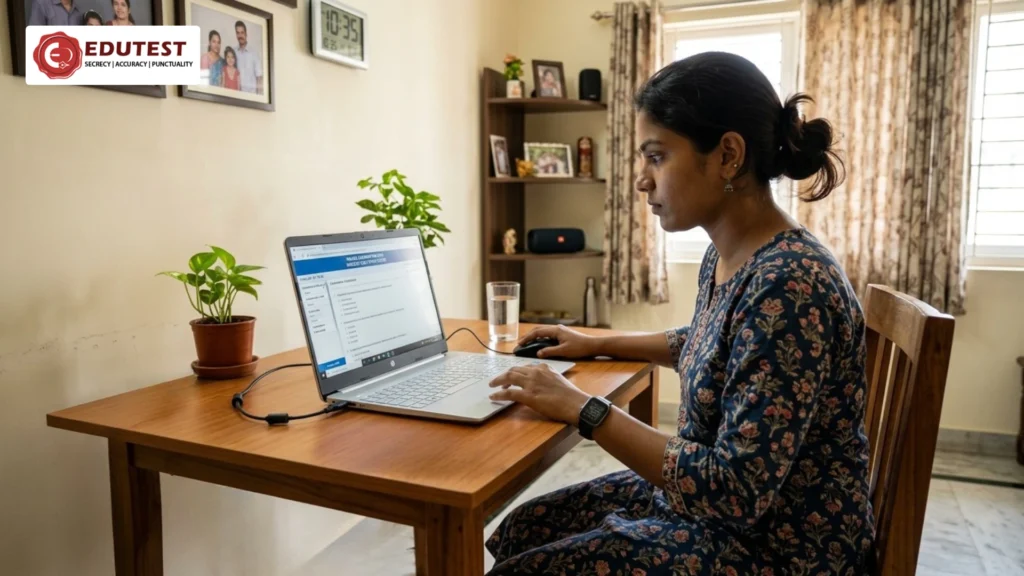
A remote proctored test allows candidates to take exams from approved locations while the system enforces supervision through monitoring and access restrictions.
The process follows a defined sequence:
- Candidate identity is verified using multi-step authentication
- The exam environment is validated through webcam monitoring
- The system enforces a secure browser with restricted access
- Sessions are monitored through live or AI-assisted exam surveillance
- Audio, video, and screen activity are recorded throughout the exam
There is no dependence on physical invigilators. Control is maintained through continuous monitoring, system restrictions, and complete session capture.
This ensures that every candidate is assessed under the same conditions, regardless of location.
Key Security Features in a Remotely Proctored Exam
A remotely proctored exam relies on layered controls that work together to reduce risk and maintain consistency.
Key control mechanisms include:
- Multi-Factor Authentication: Identity verification using credentials and biometric checks to prevent impersonation.
- Secure Browser Environment: Full-screen enforcement, blocking of screen sharing tools, and restriction of external access.
- Device and Environment Detection: Detection of virtual machines, external monitors, mobile devices, and unauthorized materials.
- Face and Presence Validation: Facial recognition and multi-face detection to identify impersonation or third-party presence.
- Continuous Audio-Video Monitoring: Real-time recording of candidate behavior for both live and post-exam review.
- Auto Proctoring and Flagging: Anti-cheating technology flags suspicious activities for review and intervention.
- Comprehensive Audit Trails: Every interaction is logged, enabling full traceability and validation.
- Command Centre Monitoring: Central teams supervise multiple sessions in real time, manage escalations, and ensure protocol adherence.
These controls operate as a system, not as isolated features.
They ensure that every session is monitored, recorded, and reviewable when required.
How Remote Proctoring Prevents Cheating and Malpractice
Prevention is embedded into the exam lifecycle.
A remotely proctored exam reduces malpractice through:
- Pre-exam controls: Identity checks and environment validation establish compliance before the exam begins.
- Real-time detection: Continuous monitoring identifies anomalies in behavior, movement, or system usage.
- Live intervention: Proctors can warn, pause, or terminate sessions based on predefined rules.
- Post-exam audit: Recorded sessions and logs provide evidence for structured review.
This ensures that candidate actions are not only monitored but also traceable. In governance-driven environments, traceability supports dispute resolution and protects overall exam integrity.
Benefits of Remote Proctored Tests for Institutions and Candidates
With control mechanisms in place, remote proctoring improves execution without compromising oversight.
For institutions:
- Conduct exams at scale without dependence on physical centres
- Reduce logistical complexity while maintaining supervision
- Standardize processes across geographies
- Access recorded data for compliance, audits, and validation
For candidates:
- Appear for exams from approved locations
- Avoid travel and scheduling constraints
- Experience consistent exam conditions
A remote proctored test extends examination capability. It supports continuity where physical infrastructure is limited, without reducing control standards.
Future of Secure Online Exams with Remote Proctoring
The adoption of secure online examinations is increasing across regulated environments.
The next phase is focused on strengthening system integration and control depth:
- More accurate behavior analysis within online remote proctored examination systems
- Stronger linkage between delivery, monitoring, and audit layers
- Defined escalation workflows within online test monitoring environments
- Enhanced data security through encryption and tamper detection mechanisms
Remote proctoring is becoming part of the core examination infrastructure rather than an additional layer.
At EduTest, this is implemented within a broader execution model. EduTest remote proctoring integrates live and automated monitoring, secure infrastructure with failover mechanisms, and process-led controls to ensure uninterrupted supervision
Because in high-stakes examinations, monitoring alone is not sufficient. Control must be continuous, and every session must be fully accountable.
That is what defines a reliable, secure online exam platform.
They use identity verification, AI monitoring, browser lockdown, and real-time supervision to prevent cheating and maintain exam integrity.
Remote proctored exams use AI-based proctoring, webcam monitoring, screen tracking, secure browsers, and real-time alert systems.
Yes, EduTest’s scalable infrastructure supports secure remote examinations for thousands of candidates simultaneously.