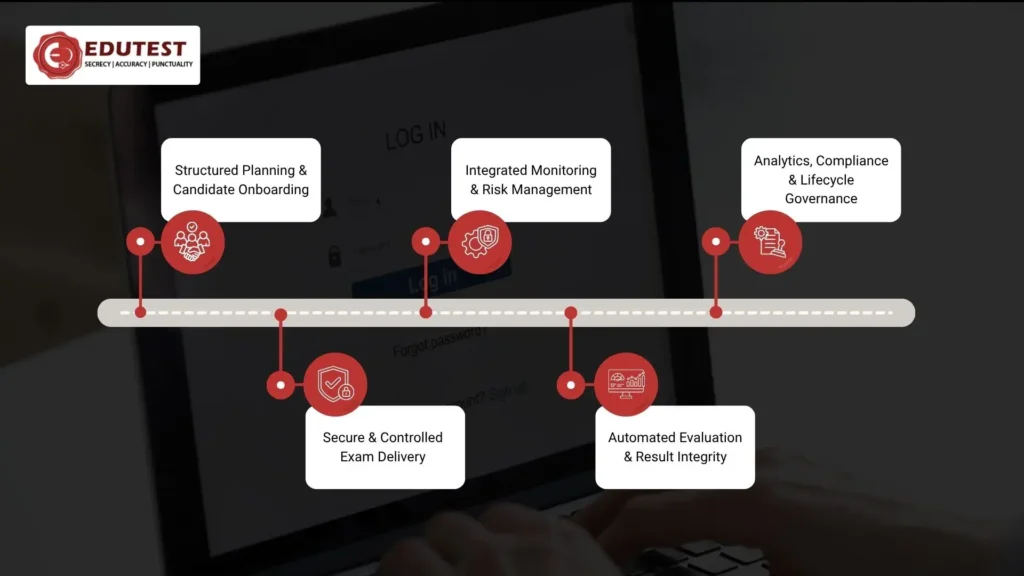
End-to-end examination services are often defined by coverage. Every stage is accounted for. Every process is mapped.
But coverage alone does not create operational control.
When assessment systems operate without embedded intelligence, they rely on manual oversight, fragmented visibility, and reactive decision-making across the lifecycle.
This is where smart assessment solutions change the structure of execution.
They do not add another layer to the process. They enable the system itself to respond, validate, and maintain consistency across every stage, from candidate onboarding to final result processing.
What Are Assessment Solutions in End-to-End Examination Services
Assessment solutions within end to end examination services refer to structured systems that manage the full exam lifecycle through defined processes, controlled environments, and integrated technology.
This is not just about moving exams online. It is about aligning –
- process workflows
- security protocols
- operational execution
- technology infrastructure
into one accountable system.
A tested setup ensures that exam integrity is not dependent on individual checkpoints, but on the system itself. This foundation enables the system to move from coordinated execution to controlled execution.
Key Components of a Smart Assessment Solution
Once the foundation is defined, the system must be built through coordinated layers that operate together.
Core components include:
- Question bank systems with role-based access and version control
- Candidate registration frameworks with validation protocols
- Exam delivery solutions adaptable to scale and geography
- Evaluation engines with automated and manual controls
- Analytics layers for decision visibility
- Audit and compliance tracking mechanisms
- Secure content custody and controlled distribution workflows
Smart assessment solutions are not defined by features alone, but by how tightly these components are integrated.
When these layers function in alignment, the system begins to produce consistent outcomes.
Benefits of End-to-End Digital Exam Management
With aligned systems, outcomes become predictable.
Digital examination services enable:
- Reduced operational fragmentation
- Consistent execution across locations
- Real-time monitoring and intervention capability
- Controlled handling of sensitive data
- Faster turnaround in evaluation and reporting
From an operator’s perspective, the real benefit is control with visibility.
At scale, predictability is more valuable than speed. To understand how this control is achieved, it is important to examine how it is built at each stage of the exam lifecycle.
Online Exam Creation and Question Bank Management
Control begins at the source.
Question bank systems must support:
- Multi-author environments
- Layered approvals
- Tagging and difficulty calibration
- Secure storage and retrieval
Without governance at this stage, downstream processes inherit risk.
An online assessment platform should not just store questions. It should enforce discipline in how they are created, reviewed, and deployed.
This ensures that the system starts with structured, validated inputs.
Secure Candidate Registration and Identity Verification
Once the assessment base is defined, the system moves to candidate onboarding.
Candidate entry points are often treated as administrative layers, when they directly impact exam credibility.
A controlled registration system ensures:
- Accurate data capture
- Document validation workflows
- Identity verification protocols
- Audit-ready records
In governance-heavy environments, this stage functions as a compliance checkpoint.
An assessment service provider must treat onboarding as a controlled process, not a formality. With verified candidates, the system is prepared for controlled delivery.
Smart Exam Delivery Platforms and Remote Proctoring
Delivery is where systems face real-world pressure.
Modern exam delivery solutions are designed to handle:
- distributed candidate bases
- varying infrastructure conditions
- secure browser environments
- remote and centre-based proctoring
Remote proctoring extends reach, but only when supported by defined monitoring protocols.
EduTest’s approach to delivery reflects this reality.
Execution is supported by command centre monitoring, structured manpower deployment, and real-time visibility into exam environments. Plus, all live examination activity is coordinated through centralized command environments that track operational status across locations in real time.
Technology enables delivery. Control ensures integrity.
Once delivery is completed, the system transitions into evaluation.
Automated Evaluation and AI-Based Result Processing
With delivery completed, focus shifts to accuracy and auditability.
Automated examination services enable:
- objective response evaluation at scale
- AI-assisted support for subjective assessments
- result normalization and validation
- exception handling workflows
Evaluation systems must not only process results quickly but also ensure they are legally defensible.
In structured environments, audit trails and validation layers are as critical as speed. With results processed, the system generates data that extends beyond outcomes.
Analytics and Reporting in Smart Assessment Systems
Data generated across the lifecycle holds operational and strategic value.
Analytics systems provide:
- Candidate performance insights
- Question effectiveness analysis
- Operational efficiency tracking
- Anomaly detection
These insights inform future exam design, policy decisions, and process improvements.
However, the value of analytics increases when it is connected to broader institutional systems.
Integration of Smart Assessment with LMS and ERP Platforms
Assessment systems do not operate in isolation.
Integrated assessment solutions connect with:
- LMS platforms for learning-to-assessment continuity
- ERP systems for administrative alignment
- Credentialing systems for result dissemination
Integration ensures that data flows across systems without duplication or loss of context.
It also strengthens continuity across the broader exam lifecycle management ecosystem.
Trusted Assessment Solutions: Data Security, Compliance, and Scalability
In governance-heavy environments, systems are evaluated on reliability, not features.
Trusted Assessment Solutions are built on:
- Secure data handling and storage protocols
- Compliance with regulatory frameworks
- Scalable infrastructure for large candidate volumes
- Controlled logistics and custody mechanisms
- Command centre monitoring for real-time oversight
EduTest operates on the principle that examination systems function as public trust infrastructures.
Execution is not just about completion. It is about defensibility.
Closing Thoughts
Across the industry, institutions are moving toward complete exam solutions that offer control, traceability, and scale.
Because in examination systems, credibility is not claimed. It is demonstrated, process by process, through disciplined execution at every stage.
End-to-end examination services cover the complete exam lifecycle, including registration, test creation, secure delivery, evaluation, and result processing.
Smart assessment solutions use advanced technologies like automation, AI, and analytics to make exams more secure, efficient, and accurate.
Yes, these solutions are designed to support large-scale exams with thousands to lakhs of candidates while maintaining performance and reliability.